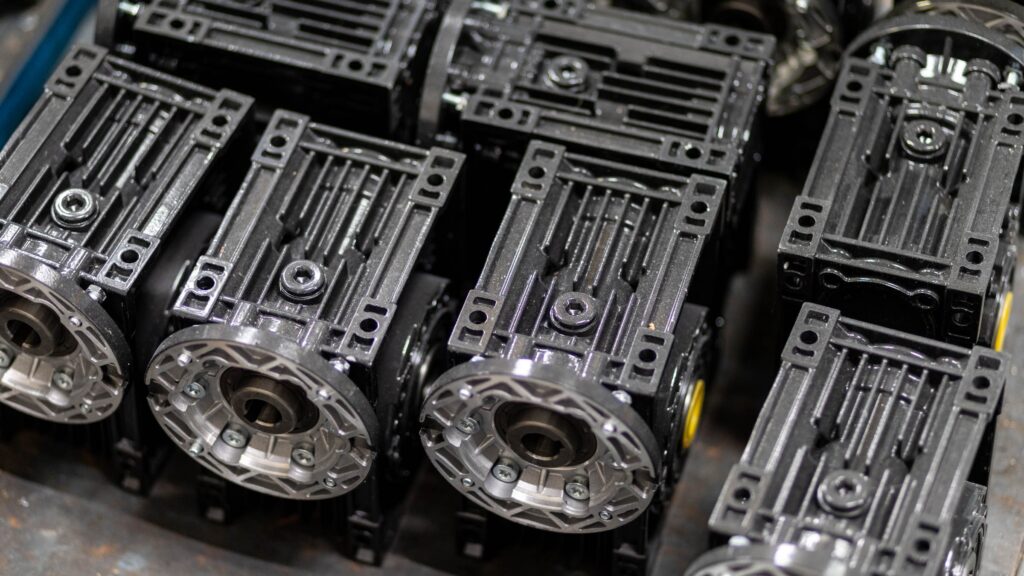
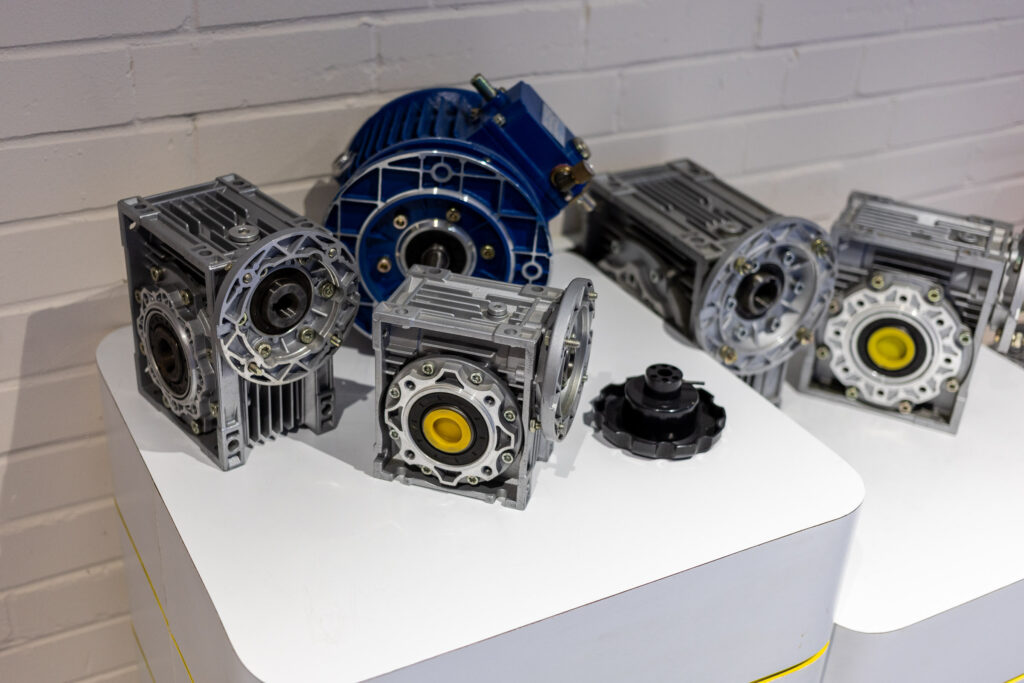
The most efficient gearboxes are helical and planetary gearboxes, at around 97-99% per stage. For right-angle drives, helical-bevel gearboxes are the most efficient option, typically 94-97% overall. Worm gearboxes are the least efficient common type, ranging from around 90% at low ratios to below 50% at high ratios. The most efficient choice for your machine depends on ratio, duty cycle, load and whether the drive must hold a load at rest.
What does gearbox efficiency actually mean?
Gearbox efficiency is the proportion of input power delivered to the output shaft:
A gearbox taking 4.0 kW in and delivering 3.8 kW out is 95% efficient. The missing 0.2 kW doesn’t disappear. It becomes heat inside the gearbox.
That heat is why efficiency matters beyond the energy bill. Every percentage point of loss raises oil temperature, shortens lubricant and seal life, and can limit how much continuous power the gearbox can transmit before it overheats.
One point engineers often miss is that a catalogue efficiency figure is a snapshot, not a constant. It is usually quoted at rated torque, rated input speed, normal operating temperature and after running-in. Move away from those conditions and efficiency changes, sometimes a lot.
Which are the most efficient gearboxes? A comparison
| Gearbox type | Typical efficiency | Why |
|---|---|---|
| Planetary | 97-98% per stage | Rolling contact, load shared across several planet gears |
| Helical (inline or parallel shaft) | 97-99% per stage | Rolling contact with smooth, gradual tooth engagement |
| Spur | 97-99% per stage | Rolling contact, but noisier than helical |
| Helical-bevel (right angle) | 94-97% overall | Efficient spiral bevel stage combined with helical stages |
| Hypoid (right angle) | Around 90-95% | Offset shafts add sliding at the tooth contact |
| Worm (right angle) | Around 30-90% | Mostly sliding contact, heavily dependent on ratio |
Ranges are typical running values. Always check the manufacturer’s data for the specific size, ratio and input speed.
The pattern is simple. Gears that roll against each other lose very little power. Gears that slide against each other lose much more. Helical and planetary gears are mostly rolling contact. A worm and wheel is mostly sliding contact, which is why worm efficiency falls sharply as ratio rises.
Why do multi-stage gearboxes lose efficiency?
Losses multiply across stages. Overall efficiency is the product of the efficiency of each stage:
| Stages | Efficiency at 98% per stage |
|---|---|
| 1 | 98.0% |
| 2 | 96.0% |
| 3 | 94.1% |
This is why a three-stage helical-bevel gearbox typically lands at around 94-96%, even though each individual mesh is highly efficient. It still outperforms a single-stage worm gearbox at almost any ratio above about 10:1.
Where is power lost inside a gearbox?
Gearbox losses fall into two groups, and the difference matters when you size a drive.
Load-dependent losses rise with the torque being transmitted:
- Friction at the tooth contact (sliding and rolling)
- Friction in the rolling bearings under load
Load-independent losses are present whenever the shafts turn, even with no load:
- Oil churning, as gears and bearings move through the lubricant
- Windage, the drag from air and oil mist at higher speeds
- Seal friction at the shaft lips
- No-load bearing drag
Because load-independent losses stay roughly fixed, they form a bigger share of the total at light loads. A gearbox running at 25% of its rated torque will usually be noticeably less efficient than the same unit at full load. Heavy oversizing therefore costs efficiency as well as money.
The international method for calculating these losses and the resulting thermal capacity is set out in ISO/TR 14179, which is worth referencing in any serious specification.
Why are worm gearboxes less efficient?
In a worm drive, the worm’s thread slides across the teeth of the wheel rather than rolling. Efficiency is governed by the worm’s lead angle and the friction between the steel worm and bronze wheel.
- Low ratios (such as 5:1 to 10:1) use multi-start worms with steep lead angles. Running efficiency can reach 85-90%.
- High ratios (such as 60:1 to 100:1) use single-start worms with shallow lead angles. Running efficiency can fall to 50% or lower.
Three further factors are often overlooked:
Lubricant has a major effect. Synthetic polyglycol (PAG) oils can noticeably improve worm efficiency over mineral oils. PAG oils must not be mixed with mineral oils and are not compatible with every seal and paint, so only change oil type on the manufacturer’s advice.
Starting efficiency is lower than running efficiency. At standstill, friction is higher than once an oil film has formed. The motor must provide enough starting torque to overcome this, which matters in frequent start-stop applications.
Efficiency improves after running-in. A new bronze wheel beds in over its first period of operation, and catalogue values usually assume this has happened.
Are self-locking worm gearboxes a safe way to hold a load?
No, not on their own. A worm set can only be statically self-locking if its forward efficiency is below 50%. But the reverse isn’t guaranteed: low efficiency doesn’t mean a gearbox will hold. Vibration, shock and running-in can all allow a statically self-locking worm set to back-drive.
If a load must be held safely, whether on a hoist, a lift table or an inclined conveyor, specify a brake motor or a dedicated holding device. Treat any self-locking behaviour as a secondary benefit, never the primary safety function.
Worked example: what does efficiency cost over a year?
Take a conveyor drive that needs 2.2 kW at the gearbox output, running 16 hours a day, 250 days a year (4,000 hours).
| Measure | Worm gearbox, 60:1 | Helical-bevel gearbox |
|---|---|---|
| Gearbox efficiency | 70% | 95% |
| Power needed at gearbox input | 3.14 kW | 2.32 kW |
| Heat generated in gearbox | 0.94 kW | 0.12 kW |
| Likely motor size | 4 kW | 3 kW |
Assuming a motor efficiency of 88% for both, the helical-bevel drive draws around 0.94 kW less electrical power. Over 4,000 hours that is roughly 3,760 kWh a year. At an illustrative tariff of 25p/kWh, that’s around £940 a year from one drive. Your actual figure depends on your own tariff and duty.
The heat figure matters just as much. The worm gearbox is producing nearly eight times as much heat, which raises oil temperature, shortens lubricant and seal life, and may push the unit towards its thermal limit in continuous duty.
Across a line of 20 similar drives, the difference becomes a meaningful operating cost over the life of the machine.
When is the most efficient gearbox not the right gearbox?
Efficiency is one factor among several. A worm gearbox can still be the right engineering choice when:
- Duty is intermittent. A gate or barrier drive running a few minutes a day loses very little energy in absolute terms.
- Space is tight. Worm gearboxes deliver high ratios in a compact right-angle package.
- Quiet running matters. Sliding contact is typically smoother and quieter than some gear alternatives.
- Shock loads are present. The bronze wheel can offer a degree of cushioning.
A helical or helical-bevel gearbox usually wins when duty is continuous, ratios are high, energy costs are a concern or heat dissipation is limited. The right answer comes from the application, not from a headline efficiency figure.
Does gearbox efficiency affect motor selection?
Yes, directly. Motor power must cover the load plus every watt the gearbox loses. A less efficient gearbox often needs a larger motor, which increases cost, current draw and heat.
In the UK and EU, electric motors have long had to meet minimum efficiency classes (IE ratings, defined in IEC 60034-30-1) under ecodesign regulations. Gearboxes have no equivalent mandatory efficiency class. This means a drive can combine a high-efficiency IE3 or IE4 motor with a gearbox that wastes a large share of that power, unless someone looks at the whole system.
How do you specify the most efficient gearbox for your application?
Before choosing, confirm:
- Correct sizing, avoiding both overloading and heavy oversizing
- Duty cycle: hours per day, starts per hour and continuous or intermittent operation
- Required output torque and speed, including peak and starting torque
- Ratio: whether a high single-stage ratio or a multi-stage helical solution fits better
- Holding requirement: whether a brake is needed rather than relying on self-locking
- Thermal capacity at your ambient temperature, not just the mechanical rating
- Lubricant type and mounting position, which both affect losses
Frequently Asked Questions
What is the most efficient type of gearbox?
Helical and planetary gearboxes are the most efficient gearboxes in common industrial use, typically reaching 97-99% efficiency per stage. They rely mainly on rolling contact between gear teeth, which generates far less friction than the sliding contact found in worm gearboxes.
What is the most efficient right-angle gearbox?
The helical-bevel gearbox is usually the most efficient right-angle option, at around 94-97% overall. Hypoid gearboxes sit slightly lower, and worm gearboxes are the least efficient, particularly at higher ratios.
What is a good efficiency for a worm gearbox?
It depends on ratio. Around 85-90% is good for a low-ratio worm gearbox (around 10:1 or below). At 60:1 and above, 50-70% is typical. Always check manufacturer data for the specific size and input speed.
Does gearbox efficiency change with load?
Yes. Some losses, such as oil churning and seal friction, stay roughly constant regardless of load. At light loads these fixed losses form a larger share of the total, so efficiency falls. Gearboxes are generally most efficient near their rated torque.
How do I calculate gearbox efficiency?
Divide output power by input power. For example, 3.8 kW out from 4.0 kW in gives 95% efficiency. For multi-stage gearboxes, multiply the efficiency of each stage together to find the overall figure.
Can a worm gearbox be replaced with a more efficient gearbox?
Often yes, typically with a helical-bevel gearbox of similar output. Check shaft positions, mounting dimensions and output speed first. If the application relied on the worm’s self-locking behaviour, add a brake motor to hold the load safely.
Does oil affect gearbox efficiency?
Yes. Oil that is too viscous increases churning losses, and oil that is too thin increases wear. Overfilling also raises churning losses. For worm gearboxes, synthetic oils can improve efficiency, but only change oil type on the manufacturer’s advice.
Is a more efficient gearbox worth the extra cost?
For continuous-duty applications, usually yes. Lower losses reduce energy use, heat, lubricant degradation and sometimes motor size. For intermittent duty, the energy saving may be small, and other factors such as size and cost may matter more.
Talk to engineers who build gearboxes
At Brown GearTech, we have spent 50 years designing, building and testing gearbox and motor systems in the UK for OEM applications where failure is not an option. We’ll help you weigh efficiency against duty, space, load holding and lifetime cost, and give you a straight answer on which gearbox suits your machine.
SPEAK TO OUR TEAM TODAY
If you’d like tailored advice on gearbox specification, speak to our engineering team today.